
A COVID-19 Prediction Model Based on Neural Network
Overview
Problem & Motivation
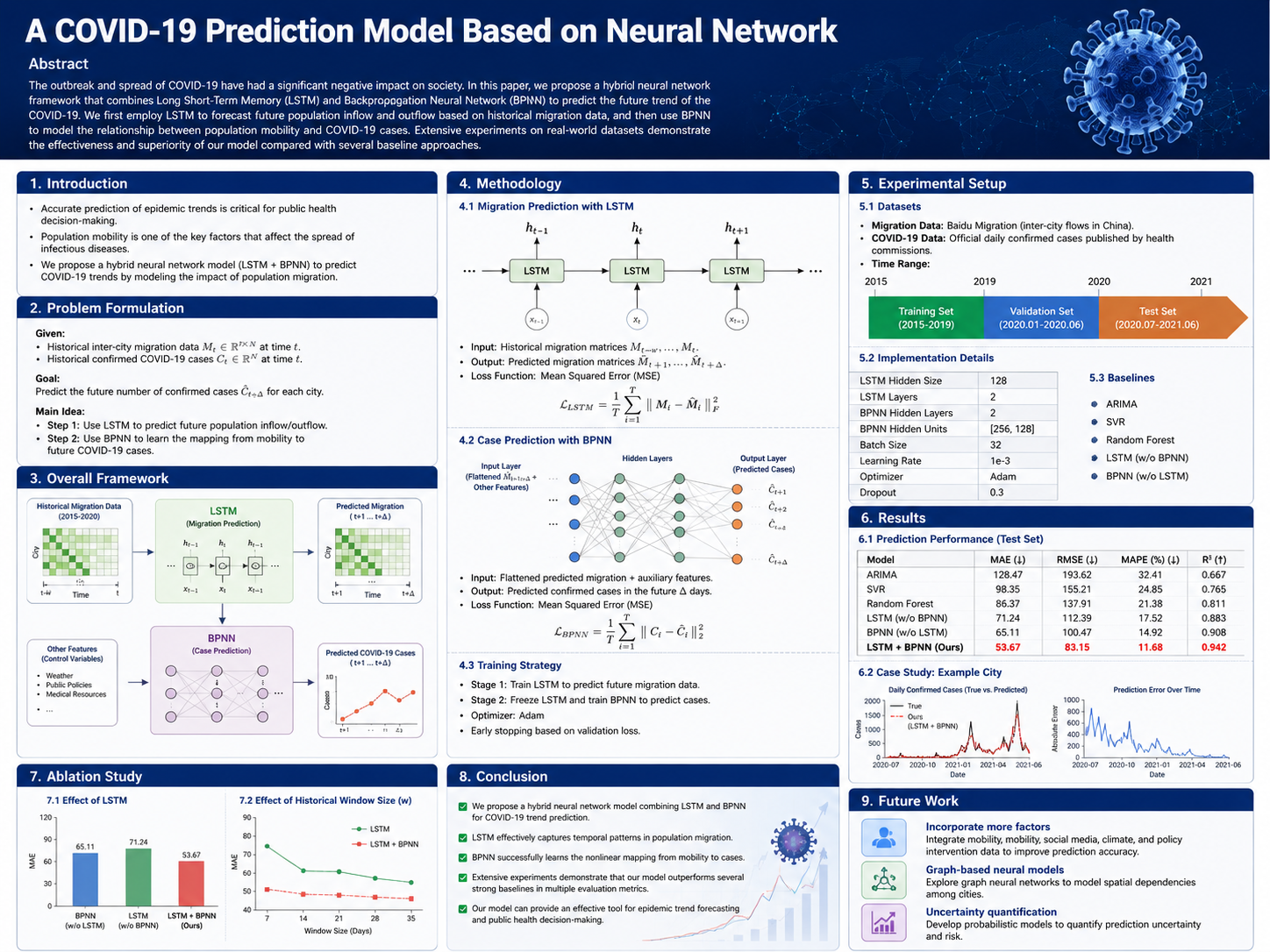
Accurate epidemic trend prediction is critical. Population mobility is a key factor, but existing models fail to effectively capture its complex temporal relationship with COVID-19 cases.
Our Approach
We propose a hybrid neural network: LSTM predicts future population inflow and outflow from historical migration data, and BPNN models the nonlinear mapping from mobility to future confirmed cases.
Results
Our model improves R² from 0.908 (BPNN alone) to 0.942, and reduces RMSE from 100.47 (BPNN alone) to 83.15, demonstrating superior predictive accuracy.
Authors and Affiliations
- Xuling Zhang — Yingkou Institute of Technology, College of Electrical Engineering, Yingkou, China
- Hong Yan — Yingkou Institute of Technology, College of Electrical Engineering, Yingkou, China
- Zhen Zhang — Yingkou Institute of Technology, College of Electrical Engineering, Yingkou, China
- Jing Zhang — Yingkou Institute of Technology, College of Electrical Engineering, Yingkou, China
- Rui Zhang — Yingkou Institute of Technology, College of Electrical Engineering, Yingkou, China
- Fuxue Li — Yingkou Institute of Technology, College of Electrical Engineering, Yingkou, China
Research Area
- Epidemic Forecasting
- Neural Networks
- Population Mobility Analysis
Key Contributions
- Proposed a hybrid LSTM+BPNN architecture for epidemic trend prediction.
- Modeled the relationship between migration dynamics and future confirmed cases.
- Demonstrated that temporal mobility patterns significantly improve forecasting accuracy.
- Validated the framework through extensive experiments on COVID-19 data.
Publication Details
- Venue: 2021 IEEE International Conference on Advances in Electrical Engineering and Computer Applications (AEECA 2021)
- Presentation Type: Oral
- DOI: 10.1109/AEECA52519.2021.9574278