
Enhanced Graph Neural Networks Using K-Hop Gaussian Diffusion
Overview
Problem & Motivation
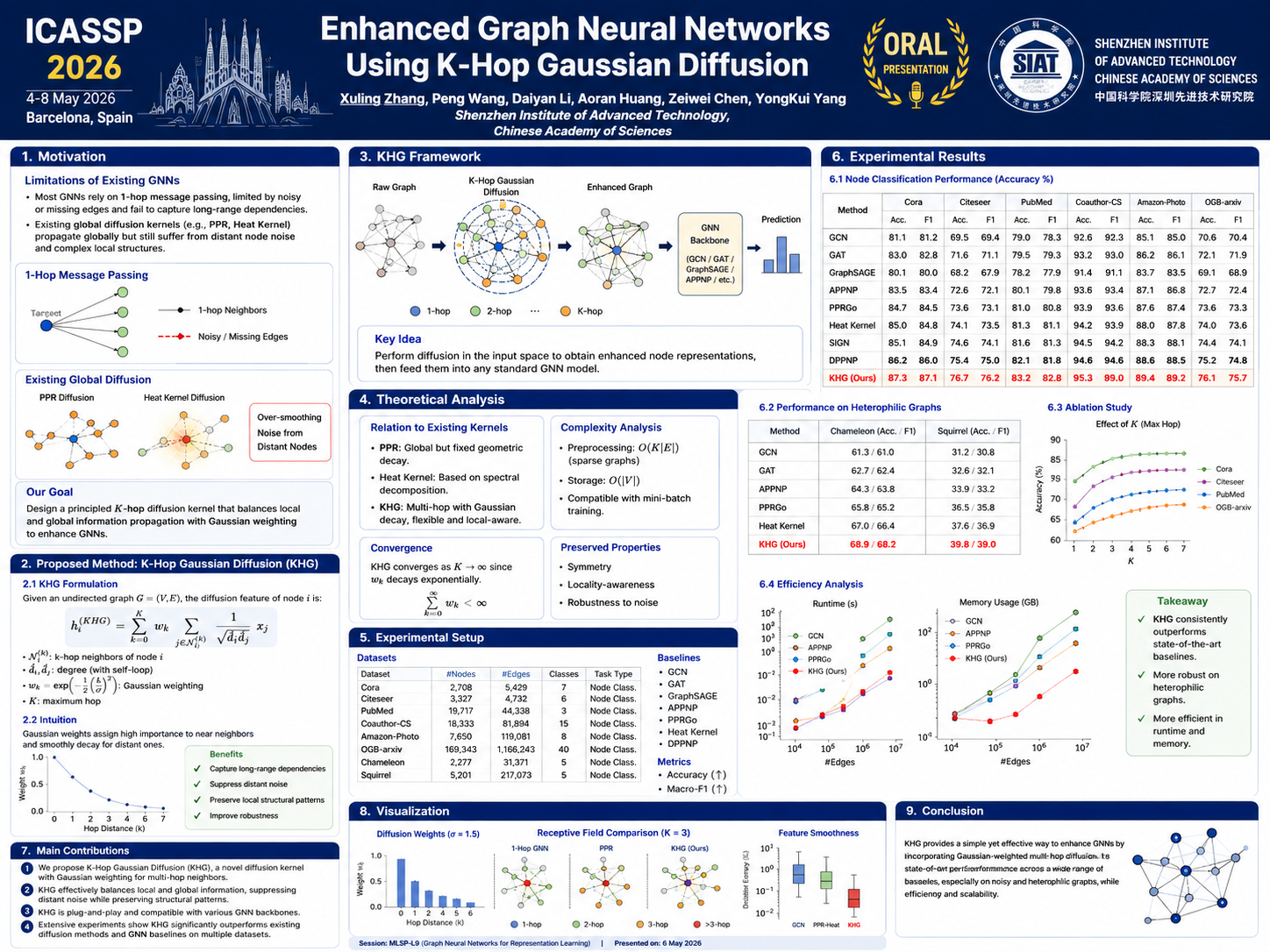
Existing GNNs rely on 1-hop message passing, failing to capture long-range dependencies and suffering from noisy or missing edges. Global diffusion kernels like PPR and Heat Kernel often propagate distant node noise.
Our Approach
We propose K-Hop Gaussian Diffusion (KHG), a novel diffusion kernel with Gaussian weighting over multi-hop neighbors. It balances local and global information, suppresses distant noise, and is plug-and-play with any GNN backbone.
Results
KHG improves accuracy on Cora from 86.2% (DPPNP) to 87.3%, and on PubMed from 75.4% (DPPNP) to 76.7%, consistently outperforming existing diffusion methods and GNN baselines.
Authors and Affiliations
- Xuling Zhang — Shenzhen Institute of Advanced Technology, Chinese Academy of Sciences, China
- Peng Wang — Shenzhen Institute of Advanced Technology, Chinese Academy of Sciences, China
- Daiyan Li — Shenzhen Institute of Advanced Technology, Chinese Academy of Sciences, China
- Aoran Huang — Shenzhen Institute of Advanced Technology, Chinese Academy of Sciences, China
- Zeiwei Chen — Shenzhen Institute of Advanced Technology, Chinese Academy of Sciences, China
- Yongkui Yang — Shenzhen Institute of Advanced Technology, Chinese Academy of Sciences, China
Research Area
- Graph Neural Networks
- Graph Diffusion
- Graph Representation Learning
Key Contributions
- Introduced a Gaussian-weighted multi-hop diffusion mechanism over graph neighborhoods.
- Improved long-range information propagation while mitigating the effect of distant noisy nodes.
- Built a plug-and-play diffusion module that can be integrated with multiple GNN backbones.
- Consistently outperformed existing diffusion-based GNN baselines on benchmark datasets.
Publication Details
- Venue: IEEE International Conference on Acoustics, Speech, and Signal Processing 2026 (ICASSP 2026)
- Presentation Type: Oral